The short answer
A grade-level door sits at pavement height and you drive through it. A dock-high door sits roughly four feet up so a trailer floor lines up with your floor. Most small industrial tenants need grade-level. You need dock-high only if freight arrives in a full-size trailer often enough that handling it any other way costs you real money. Grade-level is also what you will find at most self-storage facilities, but a contractor bay is a different product from a storage unit even when the door looks the same.
The part nobody explains: a dock-high door is not the same thing as a working dock. Three separate things determine what a dock can actually do, and listings mention none of them.
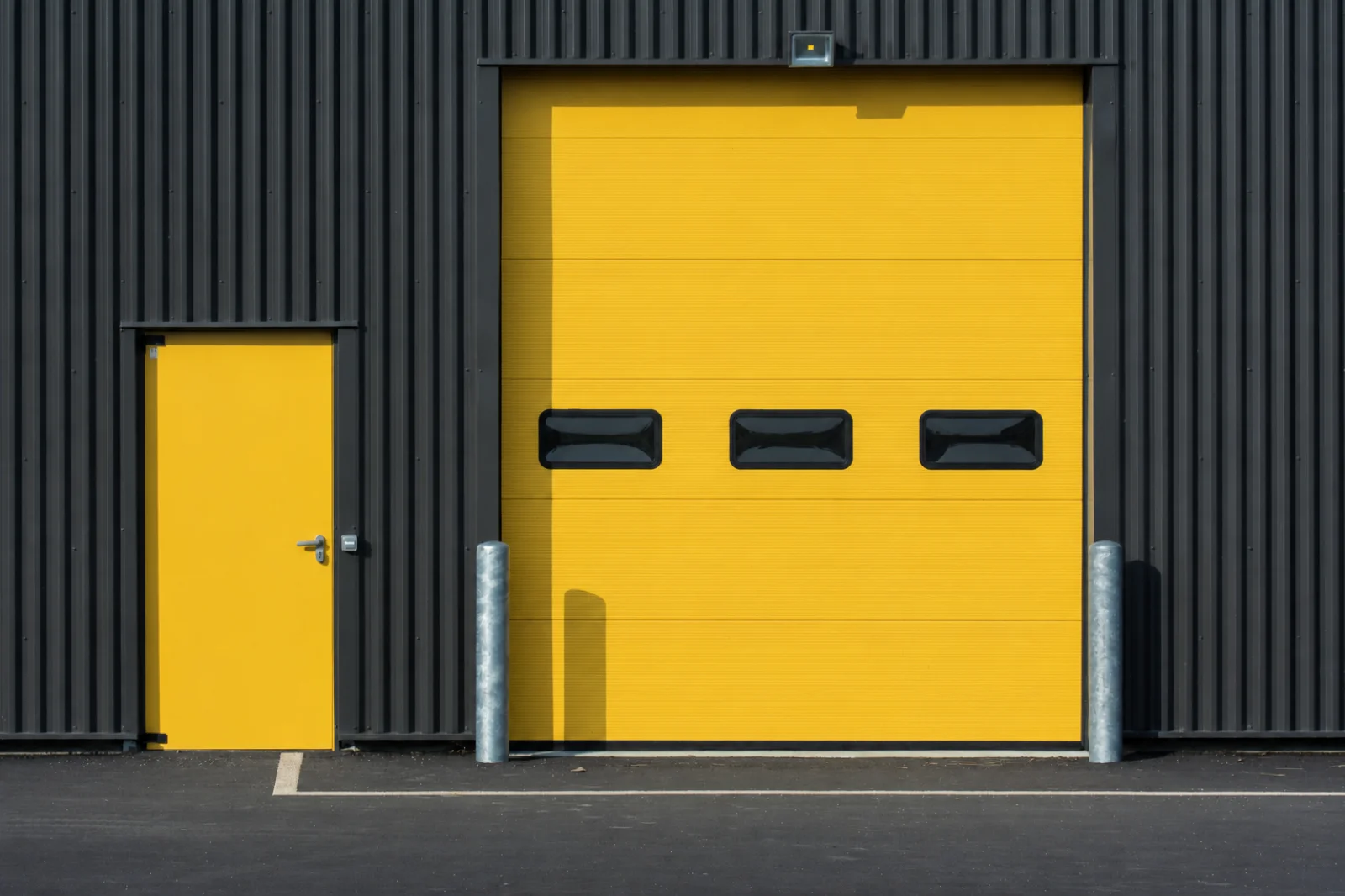
Grade-level, and why most tenants want it
A grade-level overhead door opens onto pavement. You back a pickup, a van, a trailer, or a piece of equipment straight in. No steps, no ramp, no equipment.
For a trade business this is almost always the right door. You load your own truck, you take deliveries from parcel carriers and local suppliers, and you occasionally need to get something large inside. Size matters more than anything else: a 12 by 12 door will take a dump trailer, a skid steer, most box trucks, and a truck with a rack. A 10 by 10 will not take some of those.
The limitation only shows up when a real freight truck arrives. A 53-foot trailer's floor sits about four feet above your slab, and there is no good way to get freight down that gap without a liftgate on the truck or a forklift outside.
Dock-high, and what it is really for
At a dock, the trailer floor and the building floor are at roughly the same height, so freight moves horizontally instead of vertically. That is the whole idea.
It matters most for LTL freight, meaning palletized shipments on a common carrier. Carriers charge extra to deliver where there is no dock and no forklift, because the driver has to lower each pallet on a hydraulic gate. That fee is per shipment and it recurs forever. Run the numbers against what it actually costs to rent shop space in Vermont before assuming a grade-level building saves you money once liftgate fees are added up.
Dock-high doors are rare in buildings under about 3,000 square feet, which is why small tenants who need one often end up renting more space than they want to get it. Before you go that route, work out what size shop bay your business actually needs, since square footage you are not using still costs rent every month.
Three things decide what a dock can actually do, and listings mention none of them.
1. What is on the dock face
Bumpers are the rubber blocks around the opening. They keep a backing trailer from hitting the building. They bridge nothing.
A dock plate or dock board is a portable aluminum ramp you drop across the gap. Plates run roughly $400 to $1,100 and handle hand trucks and pallet jacks, not forklifts. Boards are heavier and take small forklifts. Either is tenant-supplied.
An edge-of-dock leveler bolts permanently to the dock face and swings a lip onto the trailer bed. They handle trailers about five inches above or below dock height, at 20,000 and 30,000 pound capacities. Because they mount to the face rather than sitting in a poured pit, they can be added to a dock that never had one without demolition, at roughly $2,500 to $4,500 installed.
2. What is on the inside
This is the one nobody checks, and it decides more than the dock face does.
Behind a dock door there is either a floor at dock height, or a raised landing with the working floor below it. A landing is a platform. It might be eight feet deep, it might be twenty. If it is small, or if there is no ramp from the landing down to the shop floor, then nothing on wheels can operate through that door no matter what hardware you bolt to the outside.
A dock with a full dock-height floor is a distribution dock. A dock with a small raised landing is a receiving dock. They look identical in a photograph and they do completely different jobs.
Ask two questions on the tour: how deep is the landing inside the door, and how does material get from the landing down to the floor.
3. Whether a truck can physically get there
A full tractor-trailer needs on the order of 130 feet of clear apron and maneuvering room to set up on a dock. A 26-foot box truck needs a fraction of that.
Plenty of small buildings have a dock that no full-size truck can reach, because the lot is tight or the approach is blocked. A dock a trailer cannot get to is expensive wall decoration. Check that the apron is level at the door as well, since a trailer parked nose-up on a slope changes the height match.
What each configuration actually accepts
| Configuration | What you can do |
|---|---|
| Grade-level only | Drive in. Take liftgate deliveries to the pavement. |
| Dock door, small landing, no ramp | Hand-unload boxes and cartons at working height. No wheeled equipment. |
| Dock door, dock-height floor, plate | Pallet jack into the trailer. No forklift. |
| Dock door, dock-height floor, leveler | Pallet jack and forklift, within about five inches of height difference. |
Which one do you need
Grade-level is enough if: you load your own vehicles, deliveries arrive by parcel carrier or local supplier, and inbound material comes in a pickup or on a small trailer. This is most trade businesses, and grade-level buildings are also the easier configuration to turn up when you go looking for shop space in Rutland County, since most small industrial buildings are built that way.
A receiving dock helps if: you take regular carton or boxed freight and are tired of lifting it down off a truck bed. It saves your back and it saves liftgate charges on freight a person can carry.
You need a full distribution dock if: you move palletized freight on wheels, run fulfillment or returns, or receive raw material in bulk. Do not settle for a landing and hope.
What we have at 310 Innovation Drive
All three bays have 12 by 12 grade-level overhead doors.
Bay 3 also has a dock-high overhead door, 9 feet wide by 10 feet tall, with a dedicated apron. A dock door at 1,750 square feet is genuinely uncommon in this market.
Being specific about what it is, since the whole point of this page is that the word "dock" hides the details. Inside the door there is a raised landing roughly 20 by 8 feet, with the shop floor below it. The frame is surrounded by bumpers. There is no leveler and no plate.
What that means in practice: this is a receiving dock. Boxed and hand-carried freight comes off a trailer at working height instead of being lowered to the pavement, which is a real advantage if you take regular carton freight. It is not a pallet-handling dock. Nothing on wheels gets onto that landing, and a landing that size would not give a pallet jack anywhere to go even if it could.
We looked at whether an edge-of-dock leveler would change that. It would not. A leveler solves the gap between the dock face and the trailer, and the constraint here is on the inside, not the outside. Spending three or four thousand dollars on hardware that does not remove the actual limitation would be a nice-looking upgrade to a problem we do not have.
The lot is roughly an acre of pavement with room for a full tractor-trailer to turn and back in.
If you are running pallets, the honest answer is that Bay 3 is not built for that and you should keep looking. If you are receiving cartons, it is better than nearly anything else you will find at this size.
Frequently asked questions
What is dock height?
Usually 48 to 52 inches above the pavement, chosen so a standard trailer floor lines up with the building floor. Trailer bed heights vary by trailer type and load, which is why levelers exist.
Can I add a dock to a grade-level building?
Not realistically. It requires cutting the slab and excavating an approach. Adding hardware to an existing dock is easy. Creating a dock is not.
What is a liftgate fee?
A per-shipment charge carriers add when there is no dock or forklift and the driver has to lower freight with a hydraulic gate. Residential delivery usually carries a separate surcharge on top.
What is the difference between a receiving dock and a distribution dock?
A receiving dock has a raised landing and suits hand-carried freight. A distribution dock has a full dock-height floor and suits pallet jacks and forklifts moving between the trailer and the warehouse. The doors look the same from outside.
Do I need a forklift?
Only if you move full pallets regularly and stack them. A pallet jack handles floor-level pallet movement for a fraction of the cost, assuming the building geometry lets one operate.
Is a 12 by 12 door big enough?
For most trade equipment, yes. Check the real height of what you plan to drive in, including anything on a rack.
About this page
Written by the owner-operator of a three-bay flex building in the Rutland Airport Business Park, North Clarendon, Vermont, current as of July 2026. Equipment pricing is general market range, not a quote.
Questions about the Bay 3 dock specifically? Call (802) 417-2107 or email leasing@innovationbays.com.